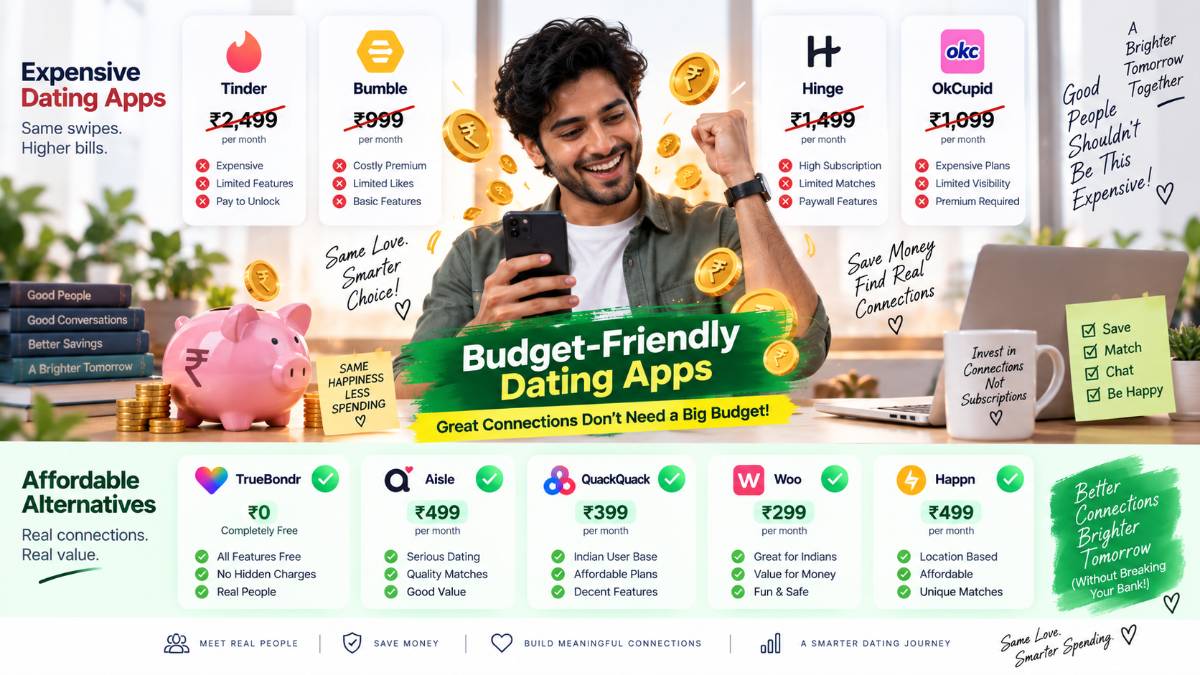
Ask someone what their dating app costs and most people cannot tell you. They know they paid something. They are not sure how much, how often, or what it bought. That vagueness is not an accident — it is the product of pricing designed to be forgettable.
This page is a breakdown of what dating apps in India actually charge in 2027. Not which app is best. What each pricing model takes from your account, where the charges hide, and how to work out your real monthly spend before you commit to anything.
One note before the numbers. App pricing in India changes constantly — companies run regional tests, festival discounts, and win-back offers for lapsed users. Two people in the same city can open the same app and see different prices on the same day. Every figure below is an approximate band based on what these apps have typically charged in the Indian market. Treat them as the right order of magnitude, not a quote. Always check the actual price on your own screen before paying.
Three ways dating apps make money, and why it matters to you
Almost every app in India runs on one of three models. The model determines everything about how the app treats you, so it is worth understanding before you look at a single price.
Model one: the flat subscription
You pay a fixed amount per month and get a bundle of features. More likes, better filters, the ability to see who liked you, maybe unlimited rewinds.
The incentive here is renewal. The app wants you to still be subscribed next month. That pulls in two directions at once — it needs you to find the service valuable enough to keep paying, but it has no particular reason to help you leave. A subscription app that gets you married on day four has lost a customer.
Of the three models, this one is the most honest about what it is. You know the number. It appears on your statement every month. Nothing is metered.
Model two: coins, credits, diamonds, tokens
Free to download. Free to browse. Free until the moment someone replies.
Then messaging costs coins, and coins cost money. Some apps charge to send. The more aggressive ones charge you to open a message somebody already sent you.
Look at the incentive honestly. The app earns when you type. It earns nothing when you exchange numbers and meet in person. Every feature in a coin app — the slow reveal, the notification that someone is "waiting for your reply", the profile that is always online — exists to extend the conversation rather than complete it.
That is not a conspiracy theory. It is just how the revenue works. A business makes more of whatever it gets paid for, and coin apps get paid for messages, not matches.
Model three: genuinely free
Messaging is unlimited and unmetered. The app may sell convenience features on the side — extra filters, visibility boosts — but conversation itself never costs anything.
Fewer apps run this way in India, and the ones that do are usually either growth-stage companies prioritising user base over revenue, or apps whose value proposition is profile quality rather than metered access.
Subscription pricing: the approximate bands
Here is roughly what the subscription tier of a mainstream dating app costs in India. Again — approximate, changes often, varies by user.
- Entry premium tier: roughly ₹400–₹900 per month. Unlimited likes, basic filters, sometimes ad removal.
- Mid premium tier: roughly ₹900–₹1,800 per month. Adds "see who liked you", which is the single feature most people actually pay for.
- Top tier: roughly ₹1,800–₹3,000 per month. Priority placement, message-before-match, monthly boost credits.
- Matrimonial platforms, which many Indian users treat as the serious alternative, price differently — typically ₹3,000–₹15,000 for a three or six month package, paid upfront.
Two things stand out when you lay it out like this.
First, the jump from entry to mid tier is usually small in rupees and large in usefulness. Apps know "see who liked you" is the conversion feature, so they place it exactly one upgrade above whatever you are currently on.
Second, ₹1,500 a month is ₹18,000 a year. That is a meaningful amount of money to spend on an outcome nobody guarantees. Worth saying plainly, because the monthly framing is designed to stop you doing that multiplication.
Coin economics: where the real money goes
This is the model most people underestimate, so it deserves the detailed treatment.
Typical Indian coin pricing works out somewhere around ₹1 to ₹3 per coin, with bulk packs lowering the per-coin rate. A starter pack is usually ₹49 to ₹99. Larger packs run ₹499, ₹999, and upward.
Now the arithmetic nobody does at the point of purchase.
Say ₹99 buys you 100 coins. Say a message costs 3 coins. That is 33 messages.
Thirty-three messages sounds like a lot until you have an actual conversation. A real exchange with one person — greetings, some back and forth, working out whether you have anything in common — runs fifteen to twenty messages easily. So ₹99 buys you roughly two conversations. Not two dates. Two conversations, which may both go nowhere.
Scale that up. If you are talking to five people in a week, which is normal on a dating app, you are looking at ₹250 to ₹500 a week. Over a month that is ₹1,000 to ₹2,000 — the same as a top-tier subscription, except you felt like you were spending small amounts.
Why starter packs are priced under ₹100
The first purchase is the hardest one to get. Everything after it is easier.
₹99 sits below the threshold where most people stop and think. It is less than a coffee. You tap it without deliberation, your UPI PIN goes in, and the transaction is done in eight seconds.
What has actually happened is that you have crossed from "free user" to "paying user", and the app's own data says paying users pay again. The second pack is bigger. The third is bigger still. By the fourth you are buying ₹499 packs and the ₹99 one feels like it was for beginners.
Where the coins go fastest
Coins drain in places you do not expect:
- Opening received messages. Some apps charge for this. You paid to read something somebody sent you for free.
- Seeing who liked you. Charged per reveal on coin apps rather than bundled.
- Sending photos. Often priced higher than text.
- Voice or video. Usually metered per minute, which means you rush the exact conversation you should be taking slowly.
- Profile boosts. Sold as "be seen by 10x more people for 30 minutes".
The last one is worth a closer look, because boosts are the purest version of this business model.
The add-on layer
Subscriptions and coins are not the end of it. Most apps run a third revenue stream of individually priced extras, and these sit outside whatever you already pay.
- Boost / Spotlight: roughly ₹100–₹400 for 30 minutes of higher visibility. Priced per use.
- Super Like / Rose / Priority Like: roughly ₹30–₹100 each, sold in packs.
- See who liked you: sometimes bundled into a tier, sometimes charged separately at ₹200–₹600.
- Read receipts: a separate purchase on some apps.
- Rewind / undo a swipe: metered on free tiers.
- Extra filters — height, education, diet, community: often locked behind the highest tier.
A subscriber who also buys two boosts and a pack of super likes in a month has not spent ₹1,200. They have spent closer to ₹2,000. The subscription was the floor, not the ceiling.
Here is the test for whether an add-on is worth it: does it get you closer to meeting someone, or does it get you more attention inside the app? Boosts are the second thing. More profile views is not the same as more compatible people.
Annual versus monthly, and the renewal trap
Every app pushes the annual plan, and on a per-month basis annual genuinely is cheaper — often 40 to 60 percent less than paying month to month.
The catch is not the price. It is the commitment and the renewal.
Most people who join a dating app are not planning to still be on it in twelve months. The entire point is to stop needing it. Buying twelve months of something you hope to abandon in three is a strange trade, however good the per-month rate looks.
Then there is auto-renew, which is on by default on essentially every plan. Twelve months after your purchase, a charge appears. Often you have not opened the app in months. Sometimes you have deleted it — and deleting an app does not cancel its subscription. This is the single most common way people lose money on dating apps in India, and it is entirely avoidable.
How to actually cancel: Google Play and UPI autopay
Cancelling is deliberately more steps than subscribing. Here is the real sequence.
For a Google Play subscription
- Open the Play Store.
- Tap your profile icon, top right.
- Go to Payments & subscriptions, then Subscriptions.
- Select the app.
- Tap Cancel subscription and complete every confirmation screen — there are usually two or three, including a discount offer designed to stop you.
You keep access until the paid period ends. You will not be charged again.
For a UPI autopay mandate
This one catches people out. If you paid through UPI autopay rather than through Google Play billing, cancelling inside the app may not stop the mandate. The standing instruction lives in your UPI app, separately.
- Open your UPI app — GPay, PhonePe, Paytm, or your bank's app.
- Find Autopay, Mandates, or Subscriptions in the settings or profile section.
- Locate the mandate for the app.
- Choose Pause or Revoke. Revoke is the one that actually ends it.
Do both if you are unsure which applies. Takes four minutes. Then check your statement the following month to confirm nothing went through.
Refunds: what Google Play will and will not do
Worth knowing before you spend, not after.
- App and subscription purchases: Google Play allows a refund request within roughly 48 hours of purchase, handled through the Play Store order history. Outside that window you are asking the developer directly, and the answer is usually no.
- Coins and in-app currency: generally treated as consumable. Once purchased, and especially once partly used, refunds are rarely granted by anyone.
- Accidental renewal: some developers will refund a renewal if you contact them promptly and have genuinely not used the service. No obligation, but worth asking politely.
- Unused coin balance when you quit: you lose it. Some apps expire coins after a set period even while you are active, so a large pack bought at a discount can quietly evaporate.
The practical upshot: treat any coin purchase as non-refundable at the moment you make it, because in effect it is.
What "free of cost" actually means
The phrase gets used for at least four different things, and only one of them is what you are looking for.
- Free to install. Meaningless. Nearly every app on the Play Store is free to install.
- Free to browse. You can look at profiles. You cannot contact anyone. This is a shop window.
- Free tier of a paid app. You get a daily allowance — often ten to twenty swipes — and then you wait twelve hours or pay. Genuinely usable, but on the app's schedule rather than yours.
- Actually free messaging. You can message anyone you match with, as much as you want, without paying or spending credits. This is the thing people mean when they search for a totally free dating app, and it is the rarest of the four.
When an app says free, work out which of those four it means before you invest any time in building a profile.
The fifty-message test
You do not need to read terms and conditions to find out what an app really costs. Run this instead.
Install it. Build a basic profile. Then send fifty messages across several conversations and count what happens.
- A wall appears around message five to ten: coin app. Your real cost will be ₹1,000–₹2,000 a month if you use it properly.
- A wall appears at a daily limit: freemium with a quota. Usable free if you are patient, costs a subscription if you are not.
- Nothing happens and you reach fifty: genuinely free messaging. This is what you were searching for.
- Everyone replies instantly and enthusiastically, and none of them will take a video call: different problem entirely. That is an operator-staffed or bot-driven app, and the cost is the least of its issues.
Before you install anything, check the Play Store listing for the In-app purchases line. If it reads something like ₹49–₹9,900 per item, you are looking at a coin app. That one line tells you more than the entire app description.
Reading the one-star reviews is the other fast check. Search them specifically for the words "coins", "credits", or "refund". Users describe the exact point where the paywall appeared, which is information the app will never give you itself.
What a free app actually costs to run
Fair question, and skipping it would make this page naive.
Running a dating app is not free for the company. Real costs include servers and bandwidth, image storage, moderation staff reviewing reports, verification infrastructure, fraud detection, customer support, and compliance work under India's data protection rules.
So how does a free app survive? Usually one of three ways. It is venture-funded and buying growth before revenue. It sells genuinely optional extras while keeping the core free. Or it is operating lean with a small team and low overhead.
None of those are sinister, but they are worth knowing, because the fourth possibility — monetising your data instead of your wallet — is the one to watch for. Read the privacy policy and check specifically whether it permits sharing personal data with third parties for advertising. An app that is free because it sells your information is not free, it is just charging in a currency you did not notice handing over. Our guide to dating sites without registration covers how to audit a privacy policy quickly.
Free trials, discounts, and the win-back cycle
Dating app pricing in India is rarely static, and the variation is deliberate.
You will see three-day and seven-day free trials that require payment details upfront and convert automatically unless you cancel. Set a reminder for the day before. Most trial revenue comes from people who meant to cancel and forgot.
Festival pricing is real — Diwali, Valentine's week, and New Year all bring discounts of 30 to 50 percent. If you have already decided to pay for something, waiting for one of these windows costs you nothing.
Then there is the win-back offer, which is the most useful thing to know. Cancel a subscription and there is a decent chance that within two to four weeks you will receive a notification or email offering a steep discount to return — sometimes half the original price. Apps price lapsed users lower than new ones because recovering you is cheaper than acquiring someone else. You do not have to game this, but it is worth knowing that the price you were shown first is not always the floor.
Metro and tier-2 pricing are not the same
Apps run regional price testing. A user in Mumbai or Bangalore often sees higher prices than a user in Indore or Coimbatore, because willingness to pay is modelled by location. The gap can be 20 to 40 percent on the same tier.
This also means screenshots of pricing you see in articles or on social media may not match what loads on your phone. Check your own screen. It is the only price that applies to you.
Working out your own real monthly cost
Before paying for anything, do this arithmetic once:
- Write down the subscription price per month, or the coin spend you expect in a week multiplied by four.
- Add any add-ons you realistically buy — boosts, super likes.
- Multiply by the number of months you expect to be looking. Be honest; most people use a dating app for three to six months at a stretch.
- Compare that total to what you would pay for the same number of months on a free app, which is zero.
- Then ask what the paid app gives you that justifies the difference.
Sometimes the answer is genuine. A larger user base in your city has real value. Better filters save time. Those are legitimate reasons to pay.
What is not a legitimate reason is being charged per message. There is no version of that where the pricing serves you rather than the company.
Where TrueBondr sits on this
Stated plainly, since this page is about pricing: TrueBondr has no coins, no credits, and no per-message charge. Messaging is unlimited and free. Reading a message somebody sent you never costs anything. There is no card required at signup.
Profiles are verified before they reach you, which is the part that makes free messaging worth having — unlimited conversations with fake accounts would be worth nothing.
Download TrueBondr and run the fifty-message test on it. That is a better basis for trusting the claim than anything written on this page.
Common questions
Which is the cheapest dating app in India?
Cheapest and free are different questions. The genuinely free apps cost nothing. Among paid apps, entry tiers start around ₹400–₹900 a month, but the cheapest subscription is often not the cheapest outcome, because low tiers tend to withhold the features that make the app usable and push you upward.
Is it worth paying for a dating app at all?
Sometimes. If an app has significantly more users in your city, or filters that save you real time, a few months of subscription can be reasonable. Paying per message is a different thing, and much harder to justify.
Why did I get charged after deleting the app?
Deleting an app does not cancel its subscription. The billing lives in Google Play or in your UPI mandate, not in the app. Follow the cancellation steps above, then verify on next month's statement.
Can I get a refund for coins I did not use?
Usually not. In-app currency is treated as consumable and is rarely refunded once bought. Assume any coin purchase is final.
Do dating apps charge men and women differently?
Not usually in the published pricing, though some apps run promotional pricing for specific segments. What differs more often is the experience — women typically receive far more incoming interest, which changes which features feel worth paying for.
Are free apps lower quality?
Not inherently. Price and quality are independent. A paid app can be full of fake profiles and a free app can be well moderated. What matters is verification, a working report system, and an identifiable company behind it. For more on how metered messaging works in practice, see our breakdown of chat apps with no coins and no money.
The short version
Subscriptions in India run roughly ₹400–₹3,000 a month depending on tier. Coin apps look cheaper and usually are not — ₹99 buys about two conversations, and regular use lands around ₹1,000–₹2,000 a month. Add-ons sit on top of whatever you already pay.
Check the Play Store in-app purchase range before installing. Run the fifty-message test. Cancel through Play Store and your UPI mandate, not by deleting the app. And work out the annual figure before you agree to the monthly one.
Free of cost is real, but it is the rarest of the four things that word gets used for. Verify it yourself rather than taking the listing's word.