The Reality of Dating With a Disability in India in 2026
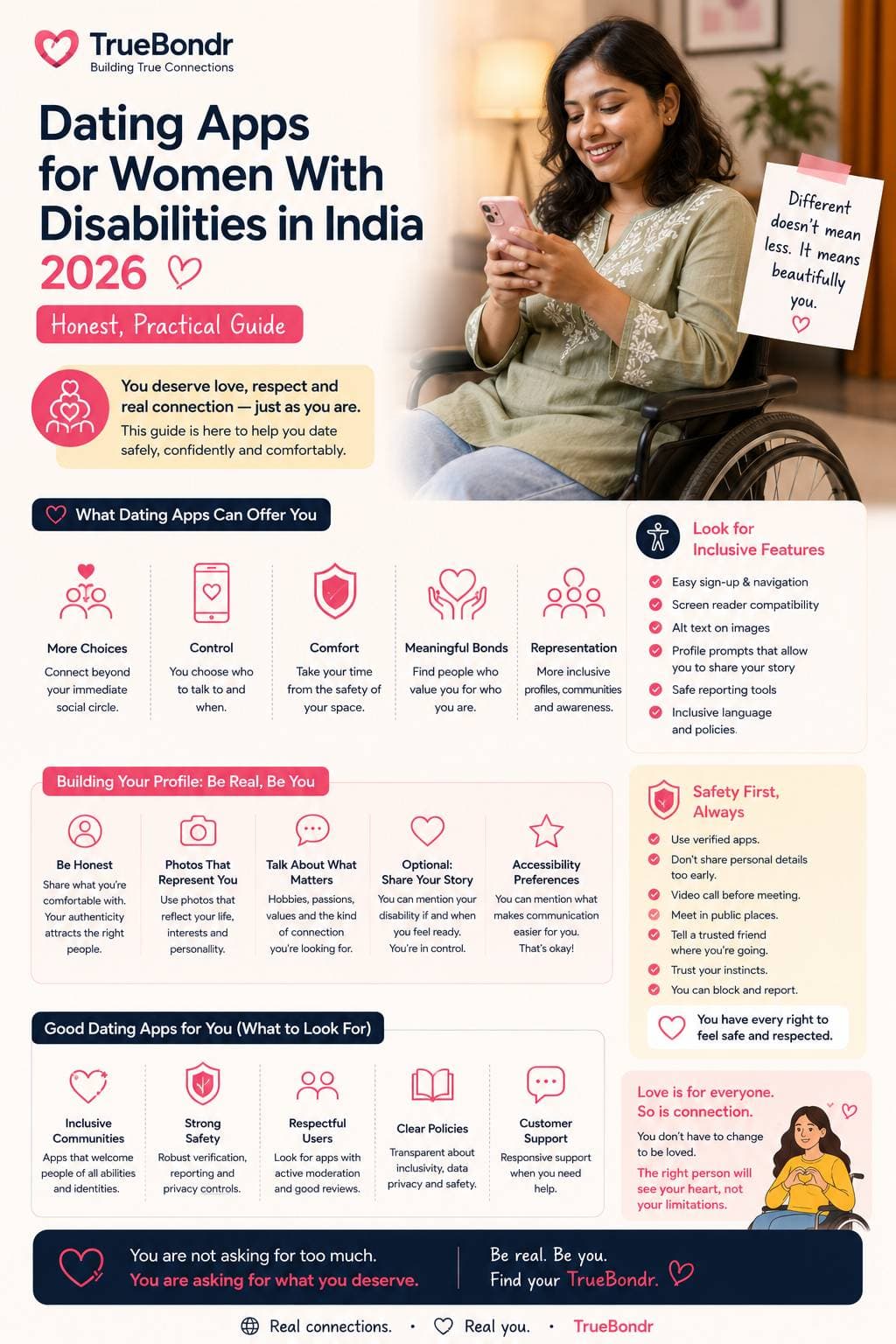
India's social landscape around disability has been changing — but dating with a disability still involves navigating specific challenges: when to disclose, how to assess genuine compatibility versus curiosity or pity, and finding platforms that don't reduce you to your disability. This guide addresses these honestly.
When and How to Disclose
In Your Profile — Your Choice
There is no obligation to disclose a disability in your profile. Some women find early disclosure useful — it filters for genuine compatibility immediately and eliminates the anxiety of when to tell someone. Others prefer to establish connection first. Both approaches have merit.
If you choose to disclose in your profile: one clear, matter-of-fact line is enough. 'I'm a wheelchair user — ADA-accessible venues work best for first dates' gives the practical information without making it the defining feature of your profile.
Before the First Meeting — Yes
Before meeting in person, your date needs to know enough to plan an accessible location. This is practical, not disclosure of personal history. A simple 'Just so you know, I use a wheelchair — we'll need a venue that works for that' is sufficient and appropriate.
Choosing the Right Platform
| Consideration | What to Look For | Best App |
| Profile verification | Know the person is real before disclosing personal info | TrueBondr — mandatory |
| Intent-matching | Serious intent only — no curiosity-seekers | TrueBondr + Hinge |
| Free access | No subscription required — access shouldn't be gated | TrueBondr |
| Safety features | Reporting, blocking, moderation | TrueBondr + Bumble |
Filtering for Genuine Compatibility
The specific challenge for women with disabilities on dating apps is distinguishing genuine romantic interest from curiosity, saviour complex, or fetishisation. Signals to watch for:
- Genuine interest: asks about your actual life, interests, personality — disability comes up naturally and without unusual focus
- Curiosity/fetishisation: significant early focus on the disability, questions that feel more like research than connection
- Saviour complex: framing of your disability as something they're magnanimously 'accepting' — not a good sign
Practical First Date Planning
- Specify accessibility needs clearly when suggesting venues — this is practical, not disclosure
- How a match responds to your accessibility requirements tells you a lot about who they are
- First meeting in a verified, busy public venue — TrueBondr's verified profiles are the baseline safety screen
FAQs
Are there dating apps specifically for people with disabilities in India?
Not major ones with active Indian user bases. General apps with verification and intent-matching — TrueBondr, Hinge — are more effective than niche apps with small pools.
What if someone's interest changes after learning about my disability?
That information — however painful — is useful compatibility data. Someone whose interest is contingent on your disability not being real is not a compatible long-term partner.
➡ Join TrueBondr free — verified profiles, real connections, no subscription required