A video call is the cheapest safety check in online dating. Two minutes on camera tells you more than two weeks of texting: whether the person matches their photos, whether the voice matches the chat, and whether they are willing to be seen at all. This guide covers free video call dating apps in India and how to use that feature properly.
Not the marketing version. The version where you actually catch someone lying.
Why video call before meeting, every time
The most common dating app problem in India is not rejection — it is misrepresentation. Old photos, borrowed photos, a different person entirely. A short video call collapses all of that instantly, before you have spent money on a coffee or travelled across the city.
Think about what a bad first meeting actually costs you. An hour each way in Bangalore traffic. Two hundred rupees on an auto. Another four hundred at a cafe you did not want to sit in. And then the slow, awkward hour of working out how to leave politely because the person in front of you is fifteen years older than their photos.
A video call costs you six minutes and about forty megabytes.
It also filters efficiently in the other direction. Someone running a scam will almost always refuse a video call, or agree and then cancel repeatedly. That refusal is your answer. You do not need to confront anyone or prove anything — you just stop replying.
Here is the part people underestimate. A video call does not only verify a face. It verifies a voice, a room, a manner of speaking, and whether the person can hold a normal conversation without a script in front of them. Text hides all four. Someone can write beautifully in chat and be completely unable to speak to you for three minutes. That is information worth having before you commit a Saturday evening to them.
What "free video call" actually means in India
Plenty of apps advertise video calling and then put it behind a paywall or a coin balance. Before you rely on it, check:
- Is it free both ways? Some apps let the paying user initiate but not the free one. If your match cannot call you back, the feature is half-useless.
- Does it cost coins per minute? Metered video calling means you will rush the exact conversation you should be taking slowly. Typical Indian pricing runs 10 to 50 coins a minute, where a coin costs somewhere between one and five rupees. A ten-minute verification call can quietly become three hundred rupees.
- Does it reveal your number? A proper in-app video call should never expose your phone number. If the app pushes you to WhatsApp instead, you have lost that protection.
- Can you end and block instantly? There should be a block button visible during the call, not buried in settings three taps away.
- Is there a time cap? Some free tiers cut you off at sixty seconds. That is enough to see a face and not much else.
Test all of this on day one, with your first match, before you care about the outcome. The worst time to discover your app charges for video is the moment you finally want to use it.
The Play Store tell
Open the app listing and look at the "In-app purchases" line. If it reads something like ₹49 – ₹9,900 per item, you are looking at a coin economy, and video calling is almost certainly inside it. Then read the one-star reviews and search them for the words "coins", "credits" or "diamonds". Users describe the exact point where the paywall appears, usually with some feeling.
Random video chat is not the same thing
Searches for free video calling often lead to random-stranger video apps — the ones that connect you to whoever is online, with no profile and no matching. These are a different category with different risks, and I would stay away from them entirely:
- No profile, no history, no accountability for the person on the other end
- Screen recording is routine, and recordings are the raw material for sextortion
- No matching at all — you are not meeting someone compatible, just someone awake
- Many are not moderated in any meaningful sense, so the content you are shown is not something you chose
- Several popular ones are built specifically to harvest the recordings, not to connect anyone
If your goal is actually to meet someone, a dating app with video verification is both safer and more effective. The call happens with a person whose profile you have already read, inside an app where they have an identity that can be reported and removed. Random chat gives you a stranger who disappears the moment they have what they came for.
The two things sound similar in a search bar. They are not remotely the same product.
How to spot a fake video call
Scammers have adapted. Some will now accept a video call and show you something that is not live. Three common versions:
The pre-recorded loop
A short clip of a real person, played back on a loop while the scammer types to you. Watch for repetition — the same head tilt, the same hair touch, the same glance to the left every twenty seconds. Loops are usually between fifteen and forty seconds long and the seam is visible once you know to look.
The deepfake or face filter
Cheaper than it used to be and genuinely convincing in still frames. It falls apart in motion. Edges blur where the face meets the hair. Glasses glitch. The jaw smears when they turn quickly.
The "broken camera" dodge
Audio only, or video so dark and pixelated that it shows nothing. They will blame the network. Sometimes the network really is bad. But a person whose camera mysteriously never works, across four attempts, does not have a camera problem.
How to break all three in ten seconds
Ask them to do something specific and unrehearsed. Not aggressively — make it light.
- "Wave with your left hand"
- "Hold up three fingers next to your face"
- "Turn your head sideways for a second"
- "Say my name out loud"
- "Scratch your nose"
A real person does it in two seconds and finds it mildly funny. A loop cannot comply at all. A deepfake usually breaks on the side profile or the hand crossing the face. And someone running a script will stall, get defensive, or suddenly lose connection.
That last reaction is the clearest signal in the whole process. Genuine people are not offended by a small verification request. Anyone who reacts with anger to "wave with your left hand" has told you exactly what you needed to know.
The first video call: what to actually say
Most people avoid the video call because they do not know how to ask for it, or they freeze once it starts. Here is a script that works.
Asking for it
Keep it casual and make it mutual. Do not frame it as an interrogation.
"Before we plan anything, want to do a quick five-minute video call? Just easier to talk than type, and good to know we are both real."
That phrasing does three things. It gives a reason that is not accusatory. It sets a time limit so nobody panics. And "we are both real" makes it symmetrical rather than a test you are running on them.
The first thirty seconds
They will be as nervous as you are. Say so.
"Okay this is slightly awkward for about thirty seconds and then it is fine."
Naming it defuses it. Then ask something easy that they cannot have prepared — what they did today, what is for dinner, whether it is raining where they are. Weather is genuinely useful here, because if they claim to be in Pune and it has been pouring in Pune all evening, their answer should match.
The middle five minutes
Talk about anything. The content does not matter much. What you are reading is whether the person on screen matches the person in the chat — same humour, same vocabulary, same energy. A mismatch is not always sinister, but it is always worth noticing.
Ending it
End before it runs out of steam. Finishing while it is still going well is the best possible note.
"This was good. I should go, but let us plan something for the weekend."
If you did not like them, you do not owe a plan. "This was nice, I will message you" is a complete sentence and you are allowed to use it.
Looking decent on camera without trying hard
None of this is vanity. Bad video makes you look evasive, and evasive is the opposite of what the call is for.
- Light in front, not behind. Sit facing a window or a lamp. If the light is behind you, you are a silhouette, and a silhouette reads as someone hiding.
- Phone at eye level. Prop it on a stack of books. Holding it in your lap gives everyone the ceiling-fan-and-nostrils angle.
- Back camera if the light is bad. The rear camera on almost every Indian phone is substantially better than the front one. Flip it, prop the phone, done.
- Check behind you. Drying clothes, a family member walking past in a towel, your building name on a courier packet. Plain wall solves all of it.
- Headphones. Kills echo, keeps the conversation private from the rest of the house, and in a joint family that second point matters more than the first.
Data usage, honestly
People skip video calls because they worry about data. The worry is mostly outdated.
- Standard quality video call: roughly 5 to 8 MB per minute
- A ten-minute call: 50 to 80 MB
- HD video call: closer to 12 to 15 MB per minute
On a typical Jio or Airtel plan with 1.5 GB to 2 GB a day, a ten-minute call is around four percent of your daily quota. You will spend more watching two Instagram reels. If you are on a tighter plan, do it on wifi, or drop the quality in settings and accept a softer picture — it still shows you a face, which is the entire point.
Patchy network is a real constraint in a lot of the country. If the video keeps freezing, say so and reschedule rather than struggling through. Just make sure it is actually your network and not a convenient excuse from the other side.
The serial rescheduler
This pattern deserves its own section because it catches careful people.
They agree to a video call. Enthusiastically. Then something comes up. Then something else. Then their phone was being repaired. Then they were travelling. Each excuse is individually plausible and they keep chatting warmly in between, so you keep giving the benefit of the doubt.
The real excuses, more or less verbatim:
- "My front camera is not working, I am getting it fixed"
- "Network is very bad in my area, let us do it tomorrow"
- "I am at my parents' place, cannot talk freely"
- "I look terrible today, next time promise"
- "My phone is in service centre"
- "I am shy, let us meet directly instead"
One or two of these is life. Four is a pattern, and the pattern is the message.
My rule: two failed attempts, then I stop proposing. I do not accuse anyone of anything. I simply stop driving the conversation forward and see whether they ever suggest it themselves. They almost never do.
Watch especially for the combination of refusing video while pushing hard to meet in person or asking about your work, your salary, or your family's situation. That mix is not shyness.
Sextortion: how it actually starts
This is the serious part, and it is common enough in India that everyone using dating apps should recognise the shape of it.
The sequence is remarkably consistent:
- Fast, flattering contact. An unusually attractive profile matches and escalates quickly. Lots of compliments, lots of attention, very fast.
- Rapid move off-platform. They push to WhatsApp within a day or two. This matters — outside the app there is no moderation and no report button.
- They initiate video. Note the inversion. Here the scammer wants the call, because the call is the trap rather than the test.
- They undress first. Often it is a pre-recorded clip. The point is to make it feel reciprocal and to lower your guard through social pressure.
- They record you. Screen recording, or a second phone pointed at the screen.
- The demand arrives. Usually within minutes. Along with it, a screenshot of your contact list or your Facebook friends, as proof they know who to send it to.
- Escalation. You pay, and the demand repeats. It never ends at the first payment.
The defence is one rule, and it is absolute. Never undress on camera for someone you have not met in person, no matter how reciprocal it feels, no matter how long you have been talking.
If the other person starts undressing unprompted on a first video call, that is not attraction. End the call. Block. Report the profile inside the app so the next person does not get the same call.
If it has already happened to you
Read this section properly even if you think it will never apply to you, because the first ten minutes of panic are when people make the expensive mistake.
Do not pay. Paying confirms you are frightened and can be made to pay again. Cases that end quickly are almost always the ones where nothing was ever sent.
What to do instead:
- Stop replying. Every reply tells them the pressure is working. Silence is the one response they have no script for.
- Screenshot everything first. The profile, the chat, the demand, the UPI ID or account number, the phone number. Capture it before you block, because blocking can hide the history.
- Call 1930. That is the national cybercrime helpline and it operates in multiple languages. Earlier is better — within the first twenty-four hours if money has moved.
- File at cybercrime.gov.in. There is a dedicated category for this kind of complaint, and you can file it without walking into a police station.
- Report to the platform. Report on the dating app and on WhatsApp. WhatsApp acts on sextortion reports reasonably quickly.
- Lock down your social accounts. Set Instagram and Facebook friend lists to private. Most of their leverage is the threat of reaching people you know.
- Tell one person you trust. This is the hardest step and the most important one. Isolation is the whole mechanism of the scam. Once another human being knows, the threat loses most of its force.
One more thing, said plainly. If this happened to you, you were targeted by people who do this professionally, at scale, to thousands of others. It is not a character failure and it is not something you deserved.
What video verification badges actually mean
Several apps show a verification tick, and they do not all mean the same thing:
- Photo verification. The user copied a pose on camera and a system compared it to their profile photos. Confirms the photos are of them. Confirms nothing about their name, age, job or marital status.
- ID verification. A government document was checked. Stronger, and much rarer, because most users will not upload an Aadhaar or a PAN to a dating app.
- Phone verification. Only proves they control a SIM. SIMs are cheap. Treat this as close to meaningless on its own.
- Social login. They have a Google or Facebook account. Also easy to fake.
A verification badge is a useful signal, not a guarantee. It raises the cost of being fake, which thins out the lazy scammers. The determined ones still get through, which is exactly why you still make the call yourself.
In-app calling versus moving to WhatsApp
Someone will suggest WhatsApp early. Usually innocently. Hold the line anyway, at least until after the first video call.
What you lose by switching:
- Your number. Once given, it cannot be taken back. It connects to your WhatsApp display picture, your status, often your real name, and on some apps your UPI identity.
- The report button. A dating app can ban a profile. WhatsApp can only block a number, and numbers are disposable.
- The record. In-app conversations can be reviewed if you report someone. WhatsApp chats are visible to nobody but the two of you.
A reasonable person will accept "let us do the first call here, then I will share my number". If someone argues hard about that, the argument itself is the information. Our guide to free dating sites without registration in India covers the wider question of how much you should hand over and when.
Single mothers and the video call
If you are a single mother dating in India, the video call does more work for you than for almost anyone else, for a few practical reasons.
Meeting in person is genuinely harder. Childcare has to be arranged, and a wasted evening is not just a wasted evening — it is a favour spent and a babysitter paid. A ten-minute video call after the kids are asleep costs you nothing and removes most of the duds.
It also lets you have the conversation about your children early, face to face, where you can read the reaction properly. Text flattens tone. On video you will see immediately whether "I am completely fine with kids" is true or polite.
Practical notes: do it after bedtime, keep the children entirely out of frame, and do not show anything identifying about where you live or where they study. Say nothing about their school. That caution is not paranoia, it is just the sensible default until you know someone.
If you are dating later in life more generally, our guide to the best dating apps for 40 plus in India goes into the scam patterns that specifically target that age group — and video calling is the main defence there too.
Metro versus small town
The social reality differs and it changes how you handle the call.
In Bangalore, Mumbai, Delhi or Pune, most people live alone or with flatmates, and taking a video call is unremarkable. In smaller cities and towns, a young woman taking a video call from an unknown man can carry real family consequences, which is why calls happen late at night, quietly, with headphones, and sometimes get cancelled at short notice.
If someone keeps rescheduling for this reason, it tends to look different from a scam. They explain the constraint, they propose specific alternative times, and they are the ones pushing to make it work. A scammer offers excuses without alternatives.
And if you are the one under that kind of constraint, headphones plus a plain wall plus a quiet hour is usually enough. You do not owe anyone a video call at a time that puts you in a difficult position at home.
Video calling on TrueBondr
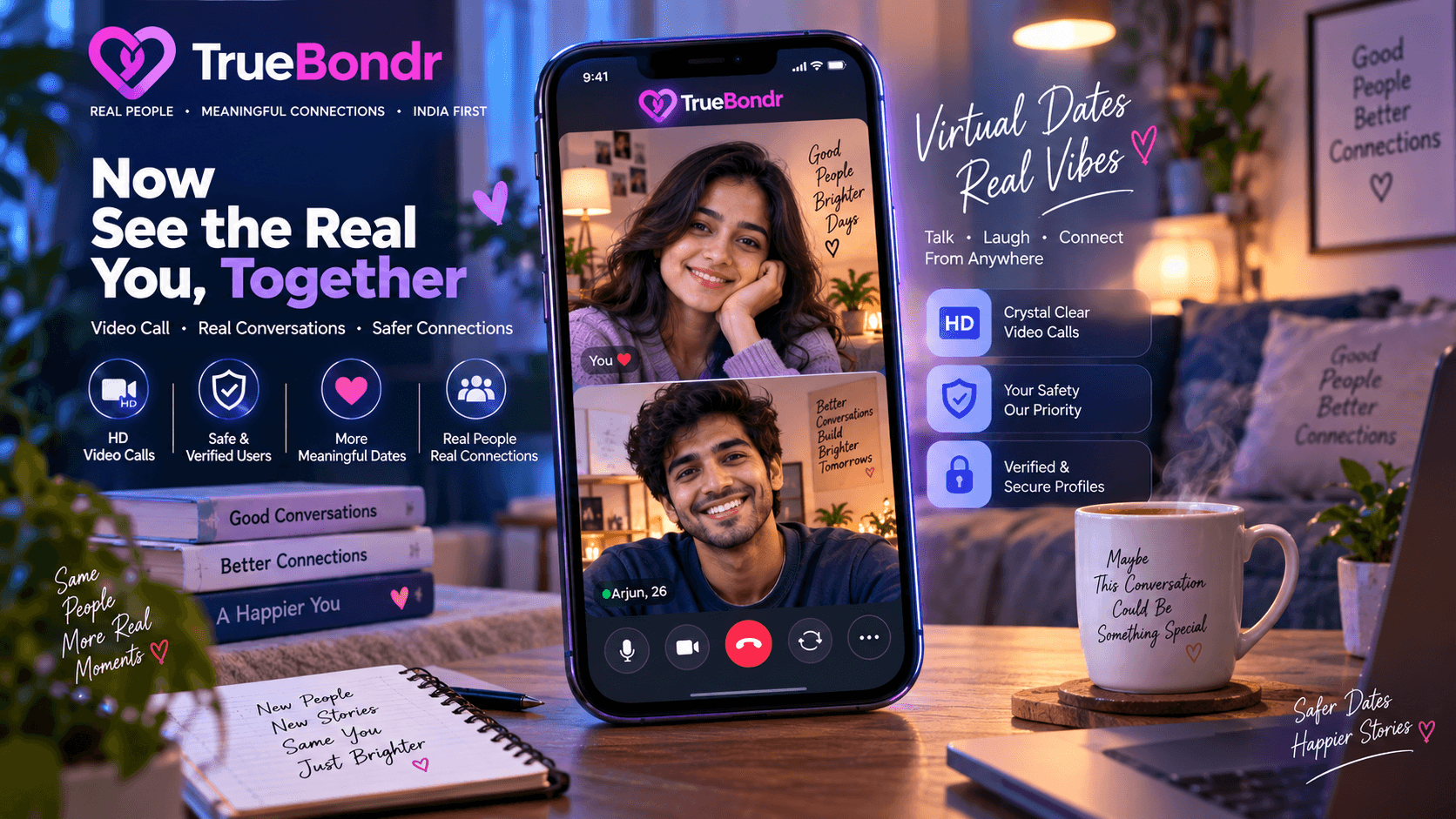
TrueBondr keeps video calling free for everyone, in both directions, with no coins and no per-minute charge. Calls run inside the app so your number stays private, and profiles are verified before they reach you — so the video call is confirming someone who already passed a check, rather than screening a complete stranger from scratch.
There is no time cap on the free tier, because a sixty-second limit defeats the purpose. And the block and report controls are on screen during the call, not buried somewhere in settings.
Download TrueBondr free to try it. Our safety guide is worth ten minutes before your first in-person meeting.
Common questions
Is video calling free on Indian dating apps?
It varies a lot. Some include it free, some charge coins per minute, some restrict it to premium users, and some cap free calls at sixty seconds. Test it early — before you are invested in a conversation — so you know what you actually have.
Does a video call use a lot of data?
Roughly 5 to 8 MB per minute at standard quality, so a ten-minute call lands under 80 MB. On a typical 1.5 GB daily plan that is about four percent of your day. Negligible compared to video streaming.
Can someone record the video call?
Assume yes, always. No app can fully prevent it — someone can simply point a second phone at the screen. This is exactly why the rule about never undressing matters. It is not about trusting the app. It is about making sure there is nothing worth recording.
Should I video call before or after chatting a while?
Earlier than feels natural. Plenty of people text for weeks and then discover the person is not who they claimed. A call within the first few days saves everyone's time, and genuine people rarely mind being asked.
What if I am too shy for a video call?
Almost everyone is, for the first thirty seconds. Say it out loud at the start and it passes. Keep it to five minutes, sit somewhere you feel comfortable, and remember the other person is just as self-conscious as you are.
Is it rude to ask someone to verify themselves on camera?
No, and anyone who treats it as an insult is telling you something useful. Frame it as mutual rather than as a test and the overwhelming majority of people are completely fine with it.
What if their camera genuinely does not work?
Then a voice call is the fallback, and it still catches a great deal — accent, tone, whether they can speak naturally. But treat a permanently broken camera across several attempts as the answer rather than the obstacle.
Can I video call without showing my face first?
Some apps offer blurred or audio-first modes that reveal gradually. Reasonable if you are nervous. Just know that a call where neither person is visible has verified nothing.
The short version
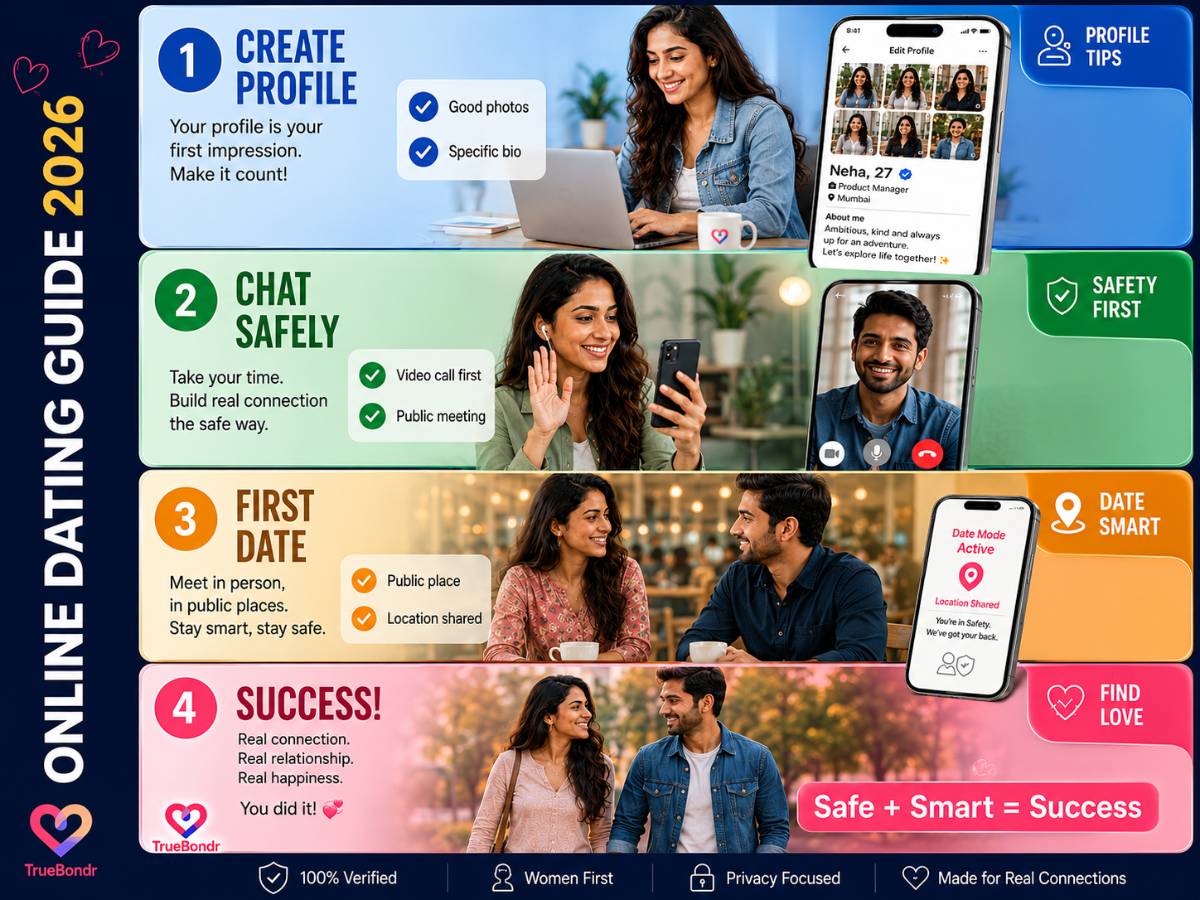
Video call every match before you meet them. Keep it inside the app, keep it to five or ten minutes, sit with light in front of you and a plain wall behind, and ask them to wave or hold up three fingers if anything looks off. Never undress on camera for someone you have not met. If someone cannot manage a short call after several attempts while still pushing to meet in person, believe the pattern rather than the excuses.
Two minutes and forty megabytes. It prevents the overwhelming majority of dating app problems in India, and it costs you almost nothing.