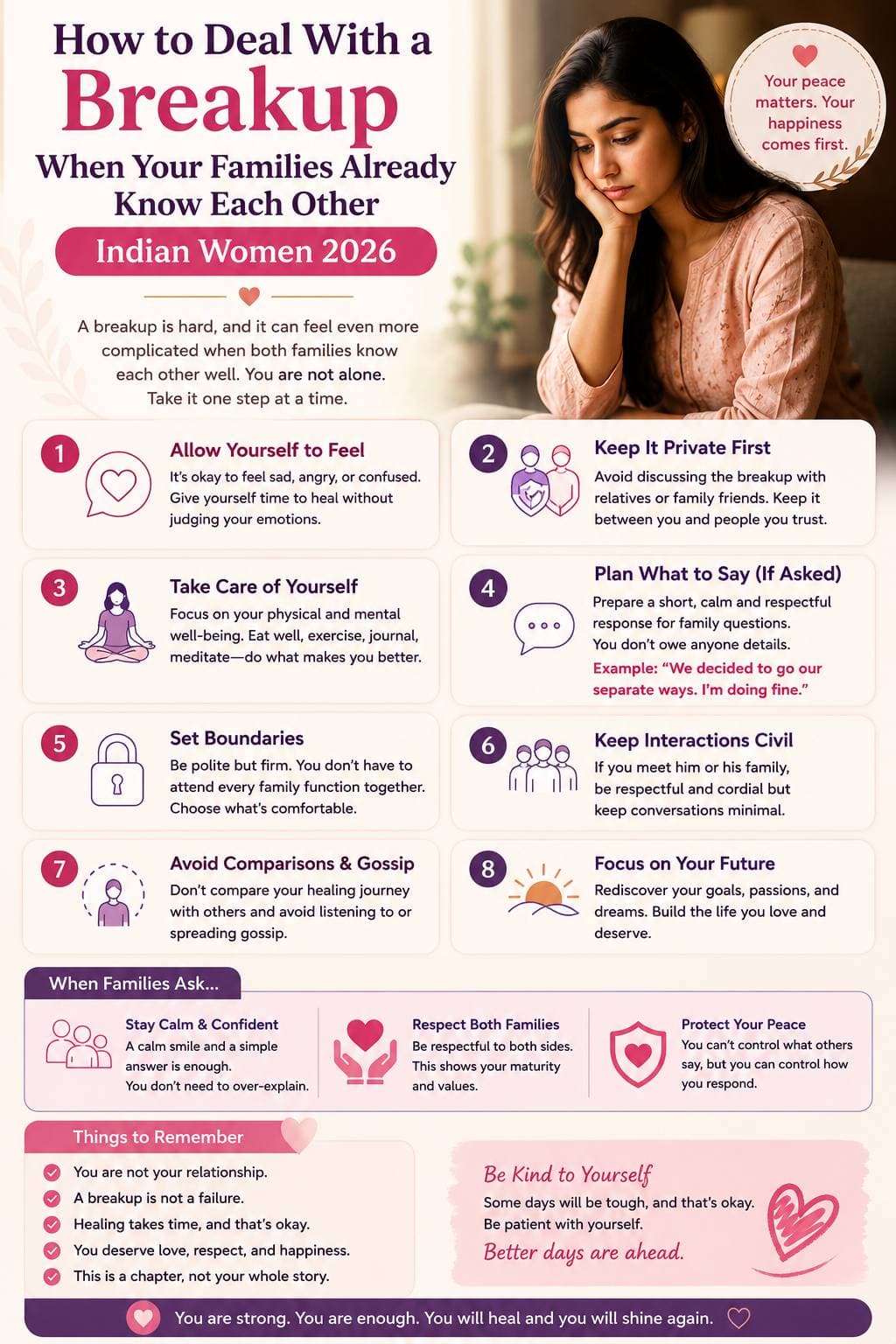
There's a kind of breakup that nobody prepares you for.
It's not the one where you and your ex were a quiet secret — no one knew, no one asks, and you can grieve in private. It's the other kind. The one where your mother has his mother's number saved in her phone. Where your cousins have met him at family functions. Where the aunties in your extended circle have already started mentally planning a future that no longer exists.
This kind of breakup doesn't just end a relationship. It ends a shared world — and then forces both of you to keep existing in the same orbit while everyone around you tries to make sense of what happened.
If you're going through this, you already know that standard breakup advice — "delete his number," "focus on yourself," "go to the gym" — doesn't quite cover it. This guide does.
Why This Kind of Breakup Hits Differently
In most Western dating contexts, a relationship is largely a private matter between two people. When it ends, the social fallout is limited. In India, a relationship that families are aware of carries a different kind of weight — and when it ends, the weight is shared in ways that make healing significantly harder.
A few specific things make this type of breakup more complicated:
Your family grieves too. Your mother might have genuinely liked him. Your father might have respected his family. When you announce the breakup, you're not just asking your family to support you through heartbreak — you're also asking them to process their own disappointment, which they'll often do loudly, with opinions, and at the least convenient times.
Every family gathering becomes a landmine. Weddings. Festivals. Colony events. Religious functions. The moment both families move in overlapping social circles, you're constantly doing the mental math of who might be there, what might be said, whether someone will ask.
You're fielding questions before you've healed. The log kya kahenge culture means that people who mean well — and even some who don't — will ask what happened before you've fully processed it yourself. You end up performing composure at a time when composure is the last thing you actually feel.
There's a loss of privacy around your pain. A private breakup lets you decide when you're ready to share and with whom. This kind doesn't give you that choice. People already know a relationship existed. The ending becomes public before you've had time to make peace with it privately.
None of this means you won't heal. It means the path to healing has extra obstacles on it — and knowing what they are in advance makes them easier to navigate.
Step One: Deal With Your Own Emotions Before You Manage Anyone Else's
The most common mistake Indian women make in this situation is immediately going into damage-control mode — managing the family narrative, fielding questions from relatives, figuring out how to behave at the next family function — before they've actually sat with their own grief.
You cannot manage a complicated external situation from a place of emotional chaos. Give yourself the space to feel what you feel first.
That means:
Letting yourself be sad without a timeline. "Log kya sochenge agar itne dino se ro rahi hoon" is not a useful thought right now. Grief doesn't run on a socially acceptable schedule.
Not performing "fine" for the benefit of people who aren't owed that performance. You don't have to seem okay before you are okay. You especially don't have to seem okay to people who will report back to the wider family network.
Finding at least one person you can be completely honest with. A close friend who isn't connected to either family. A cousin who genuinely has your back. Possibly a therapist. You need at least one space where you don't have to carefully manage your words.
The emotional work has to come before the practical navigation. If you skip it, you'll find yourself managing appearances while falling apart underneath — which is exhausting in a way that compounds over time.
Step Two: Decide What You Will and Won't Share — and Hold That Line
One of the most important decisions you'll make in this situation is how much of the breakup story you share, with whom, and how.
The natural instinct — especially when you're hurt — is to explain. To tell your side. To make sure the right people know the truth about what happened. This instinct is understandable, but it's worth pausing before you act on it.
Here's the reality: in a situation where both families know each other, information travels. Whatever you say to your mother will likely reach his mother's ears eventually, through whatever social thread connects them. Whatever version of events circulates in your extended family will become the version people carry into every future interaction.
Some practical guidance:
Decide on a simple, neutral "public" version. Not a lie — just a version that doesn't require you to justify yourself or run down him. "We realised we weren't right for each other" is complete. "We both decided to move on" is complete. You don't owe anyone a detailed account.
Reserve the full truth for people who have earned it. Your closest confidants deserve honesty. The family WhatsApp group does not.
Avoid the urge to correct the narrative publicly. If a version of events is circulating that you know is inaccurate, your impulse will be to correct it. Sometimes, letting inaccurate stories quietly die is less damaging than the engagement that comes from addressing them.
Don't make statements in anger that you'll have to manage later. In the immediate aftermath of a painful breakup, it can feel satisfying to say something sharp about him or his family to a relative who asks. That statement will outlive the satisfaction. Think about how the words will land at the next Diwali gathering — because they will come up again.
Step Three: Navigate the Shared Social Calendar with a Plan
The first family event after the breakup is the hardest. After that, it gets incrementally more manageable — but only if you've thought about it in advance rather than white-knuckling your way through each occasion as it arrives.
Decide early whether attending together (or in the same space) is workable. If both families will be at a wedding or festival, you have a few options: attend and be civil, attend separately by coordinating with your family about timing, or — for the very first major event — take a pass if you genuinely need more time. None of these options are wrong. Pick the one you can actually execute with your dignity intact.
Brief a trusted person at each family event. This is the cousin or the close family friend who will run interference when a well-meaning aunty heads toward you with questions. Something simple: "Please just redirect if someone tries to bring it up — I'm not ready to talk about it publicly yet."
Have a one-line response ready for the inevitable questions. At some point, someone at a family gathering will ask. Having a prepared response means you don't have to think on your feet in a moment that's already emotionally charged. Something like: "It just didn't work out — I'm doing well, though. How are the kids?" — redirect and move on. The conversation pivot is your friend.
Don't let the fear of running into him stop you from living your life. This is easier to say than to do. But withdrawing from every social space where he might appear gives his presence more power over your life than it deserves. The first run-in will be uncomfortable. The second will be less so. Over time, the weight lifts.
Step Four: Managing Your Family's Reactions (Because They Will Have Them)
Your family's reaction to this breakup will depend enormously on how involved they were, how much they liked him, and how much they had already mentally invested in a future that included him.
Some families are supportive and wrap around you. Others manage their own disappointment in ways that add to your burden — questioning what you did wrong, comparing you unfavourably to women who are "settled," or pushing you toward the next relationship before you're ready.
A few things worth knowing:
Your family's disappointment is not your responsibility to fix. They're allowed to be sad about a relationship that ended. You're allowed to grieve without taking on their grief as well.
"When will you find someone else?" is often disguised worry, not cruelty. Most Indian parents express concern about their children's futures through questions about marriage and relationships. Understanding where the question is coming from doesn't mean you have to answer it — but it can help you respond with less anger and more patience.
Set a quiet, firm boundary around the timeline of your healing. A simple: "I know you're worried, and I appreciate it. But I need some time before I'm ready to talk about moving forward — I'll let you know when I'm there" is enough. You don't owe anyone a date by which you'll be over it.
If a family member is actively making things worse — sharing information, taking sides loudly, making comments that are landing like attacks — it's okay to limit that particular relationship for a period of time. Protecting your healing is not disrespect.
Step Five: What to Do About His Family
This is the part that most breakup guides ignore entirely: what about his family, specifically?
If you had a relationship with his mother, his siblings, or others in his circle, the breakup doesn't automatically erase that — but it does change it. How you handle those relationships depends on the specific situation.
If his family members reach out to you directly: You're not obligated to engage, but a brief, warm, non-detailed response is usually better for everyone's long-term peace than silence. "Thank you for thinking of me — I wish your family well" closes the door gently without drama.
If you're connected on social media: There's no one right answer here. Muting (rather than unfollowing or blocking) is often the lowest-drama option in a context where mutual social circles will notice and comment on such things. You can always adjust later.
If both families remain in contact: This is the hardest scenario. If your mother and his mother still move in the same social circles, you may not be able to fully separate yourself from his family's presence in your life. What you can control is how you conduct yourself when these intersections happen — with dignity, brevity, and a refusal to be drawn into comparisons or updates about his life.
Step Six: Rebuilding When You're Ready
The families knowing each other can make the early months feel like the breakup has no edges — like you can't find the place where it ends and your normal life begins again. That feeling passes.
At some point, you will be ready to move forward. Not to pretend it didn't happen. Not to rush into something new just to prove you're over it. But genuinely ready to think about what you want next.
When that moment comes — and it will — go toward it on your own terms. Not because someone in the family has an opinion about your timeline. Not because a wedding season is approaching. Because you've done the work, you know yourself better than you did before, and you're genuinely curious about what's next.
The complicated part of a breakup where families are involved is the shared social world. The hopeful part is that the same close-knit community that makes the ending painful is also the one that, over time, quietly closes ranks around you — because in most Indian families, when the grief settles, you remain the person they love.
A Final Note
The loneliest thing about this kind of breakup is the feeling that you have to hold yourself together in every room — that there's no space where you can simply be in the middle of it without managing how it looks.
If that's where you are right now, the first thing to do is find that space. A friend who lets you be a mess. A professional who holds the space without judgment. A corner of your life that belongs only to you.
The families, the social calendar, the aunties with their questions — all of that is navigable. Start with yourself.
When you're ready to start again — on your own terms, with someone who meets you where you actually are — TrueBondr is where Indian women find connections that are real, verified, and built around what they actually want.
[Download TrueBondr — Free for Indian Women →]